

How To Install Plugins For Intellij
Install plugins
Plugins extend the core functionality of IntelliJ IDEA. For instance, install plugins to get the post-obit features:
-
Integration with version command systems, issue trackers, build management servers, and other tools.
-
Coding assist support for diverse languages and frameworks.
-
Shortcut hints, live previews, File Watchers, and and then on.
-
Coding exercises that tin can help you to learn a new programming language.
Open plugin settings
-
Press Ctrl+Alt+S to open the IDE settings and select Plugins.

Utilize the Marketplace tab to browse and install plugins from the JetBrains Plugin Repository or from a custom plugin repository.
Use the Installed tab to browse bundled and installed plugins, enable, disable, update, or remove them. Disabling unnecessary plugins can increase performance.
Most plugins can be used with whatever JetBrains production. Some are limited only to commercial products, others require a separate license.
If a plugin depends on another plugin, IntelliJ Thought volition notify you about the dependencies. If your projection depends on sure plugins, add together them to the list of required plugins.
If existing plugins do non provide some functionality that you need, you can create your own plugin for IntelliJ IDEA. For more data, encounter Develop your own plugins.
By default, IntelliJ IDEA includes several bundled plugins. You can disable bundled plugins, but they cannot be removed. You can install additional plugins from the plugin repository or from a local annal file (ZIP or JAR).
Install plugin from Marketplace
-
Press Ctrl+Alt+S to open the IDE settings and select Plugins.
-
Find the plugin in the Market and click Install.
To install a specific version, get to the plugin folio in the JetBrains Plugin Repository, download and install it every bit described in Install plugin from disk. For example, y'all can do it if the nigh contempo version of the plugin is cleaved.
Install plugin from disk
-
Download the plugin annal (Nothing or JAR).
-
Press Ctrl+Alt+S to open up the IDE settings and select Plugins.
-
On the Plugins folio, click
 and then click Install Plugin from Disk….
 -
Select the plugin archive file and click OK.
-
Click OK to employ the changes and restart the IDE if prompted.
Remove plugin
-
Press Ctrl+Alt+S to open the IDE settings and select Plugins.
-
Open up the Installed tab and find the plugin that you desire to remove.
-
Click
on the plugin'south description pane and select Uninstall.
Disable plugin
You lot can disable a plugin without removing it if you lot do not need the respective functionality.
-
Printing Ctrl+Alt+S to open the IDE settings and select Plugins.
-
Open the Installed tab, find and select the plugin that you want to disable.
-
Click
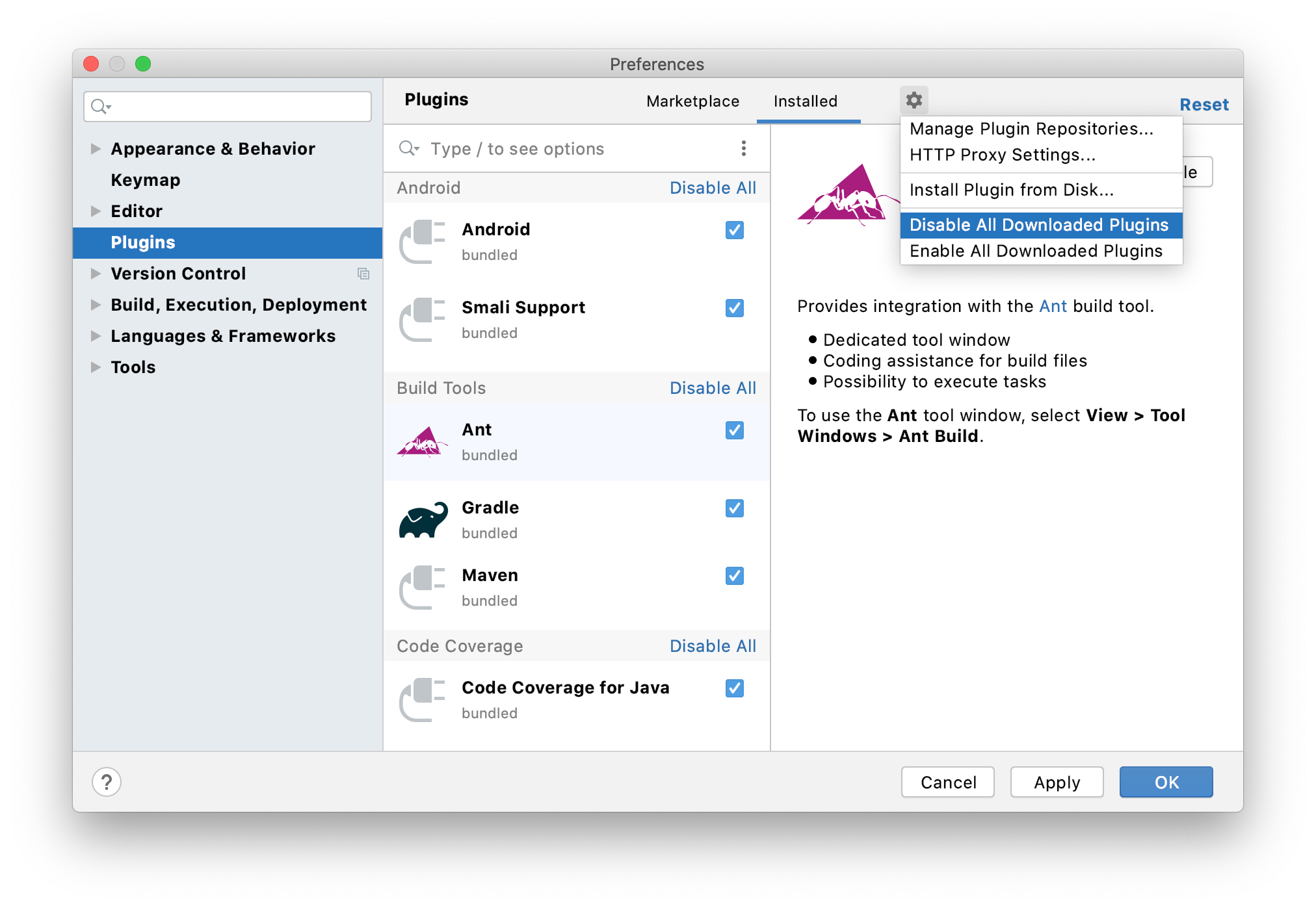
on the plugin'due south description pane and select Disable.Alternatively, you can apply the checkboxes in the list of plugins or the Disable All buttons for plugin categories.
Yous tin disable or enable all manually installed plugins at once (non-bundled) in the menu nether .
Required plugins
A project may require plugins that provide support for certain technologies or frameworks. You tin add such plugins to the list of required plugins for the current project, so that IntelliJ IDEA will verify that the plugins are installed and enabled. It will notify yous if you forget virtually some plugin, or someone on your team is not aware about the dependency as they work on the projection.
Add a required plugin for your current project
-
Make sure the required plugin is installed.
-
Press Ctrl+Alt+Southward to open the IDE settings and select Build, Execution, Deployment | Required Plugins.
-
On the Required Plugins page, click
 and select the plugin. Optionally, specify the minimum and maximum version of the plugin.
When you lot open up the project in IntelliJ Idea, information technology will notify y'all if the plugin is disabled, not installed, or requires an update.
Click the link in the notification message to chop-chop enable, install, or update the required plugin.
Suggested plugins
When you open a project, IntelliJ IDEA can suggest installing and enabling plugins based on libraries and facets used in your project. Do not misfile suggested plugins with required plugins that y'all tin can manually add to a project and then that your teammates as well utilize it.
If you don't need a particular plugin, you lot can forestall IntelliJ IDEA from suggesting it. You can besides use your notification settings to disable or enable notifications of all plugin suggestions and the way they are displayed.
Disable suggestions of a plugin
-
When a notification of a suggested plugin appears, click Practice non propose this plugin.
Adjacent time when y'all open a project, IntelliJ IDEA will not suggest this plugin. You can still check your project for suggested plugins.
Check a project for suggested plugins
-
Press Ctrl+Shift+A and starting time typing Check Suggested Plugins.
-
Select the Check Suggested Plugins action.

-
If IntelliJ IDEA has a plugin applicable to your projection, you'll come across the notification message. Click the link in the notification message to install or enable the suggested plugin.
Develop your ain plugins
You can use any edition of IntelliJ IDEA to develop plugins. Information technology provides an open API, a dedicated SDK, module, and run/debug configurations to assistance you.
The recommended workflow is to use Gradle. The old workflow using the internal IntelliJ Idea build organization is likewise supported. For more than data, see the IntelliJ Platform SDK Developer Guide.
Custom plugin repositories
Past default, IntelliJ Thought is configured to use plugins from the JetBrains Plugin Repository. This is a public repository where everyone tin can host their plugins. However, if you develop plugins for internal use only, you can set upwardly a custom plugin repository for them.
For information nearly setting upwardly a custom plugin repository, see the IntelliJ Platform SDK documentation.
Once y'all set your plugin repository, add it to IntelliJ Thought:
Add together custom repositories
-
Press Ctrl+Alt+S to open the IDE settings and select Plugins.
-
On the Plugins page, click
and select Manage Plugin Repositories…. -
In the Custom Plugin Repositories dialog, click
and specify your repository URL. Information technology must betoken to the location of the updatePlugins.xml file. The file can be on the same server every bit your custom plugins, or on a defended ane.
-
Click OK in the Custom Plugin Repositories dialog to save the list of plugin repositories.
-
Click OK in the Settings/Preferences dialog to utilise the changes.
When you search for plugins, IntelliJ Thought will show you results both from the default JetBrains Plugin Repository and whatever custom repositories that you lot specify. To browse but a certain custom plugin repository, type repository: followed by the URL of the repository in the search field on the Marketplace tab of the Plugins folio. For case:
repository:http://plugins.example.com:8080/updatePlugins.xml myPlugin
Alternatively, y'all tin can add your custom plugin repositories using the thought.plugin.hosts holding:
-
From the main card, select .
-
Add together the
thought.plugin.hostsproperty to the platform backdrop file and specify the URL of the updatePlugins.xml file. For example:idea.plugin.hosts="http://plugins.example.com:8080/updatePlugins.xml"
-
Restart IntelliJ Thought.
You may want to replace the default JetBrains Plugin Repository with your custom plugin repository. This can be helpful if you want merely your custom repository plugins to exist available from IntelliJ IDEA.
Replace the default plugin repository
-
From the main menu, select .
-
Add the
thought.plugins.hostproperty to the platform properties file and specify the URL of the application that tin properly handle requests from IntelliJ Thought, that is, human action as the default plugin repository application instead of JetBrains Plugin Repository.In detail, it should handle the post-obit requests:
-
Get the list of plugins
-
Download the latest plugin update
-
-
Restart IntelliJ IDEA.
If y'all supplant the default plugin repository, the search field on the Marketplace tab of the Plugins dialog will browse simply the plugins in the new default repository and whatever custom repositories that you add.
Productivity tips
Filter and sort search results
-
Blazon a frontwards slash
/in the search string to see options for filtering and sorting search results. For case, you can add together the post-obit options to your search string to listing only language-related plugins and sort them past the number of downloads:/tag:Languages /sortBy:downloads
Final modified: nineteen March 2022

Source: https://www.jetbrains.com/help/idea/managing-plugins.html#:~:text=ZIP%20or%20JAR).-,Press%20Ctrl%2BAlt%2BS%20to%20open%20the,IDE%20settings%20and%20select%20Plugins.&text=and%20then%20click%20Install%20Plugin,restart%20the%20IDE%20if%20prompted.
Posted by: irvincagoodge.blogspot.com
0 Response to "How To Install Plugins For Intellij"
Post a Comment